Al dente is not a compromise between raw and cooked. It is a precise cooking point where the core of the pasta keeps a firm resistance under the tooth, while the outside has absorbed the water perfectly. One second too long and the texture collapses. The Italian method comes down to a few strict rules applied in the right order.
Water, salt and proportion
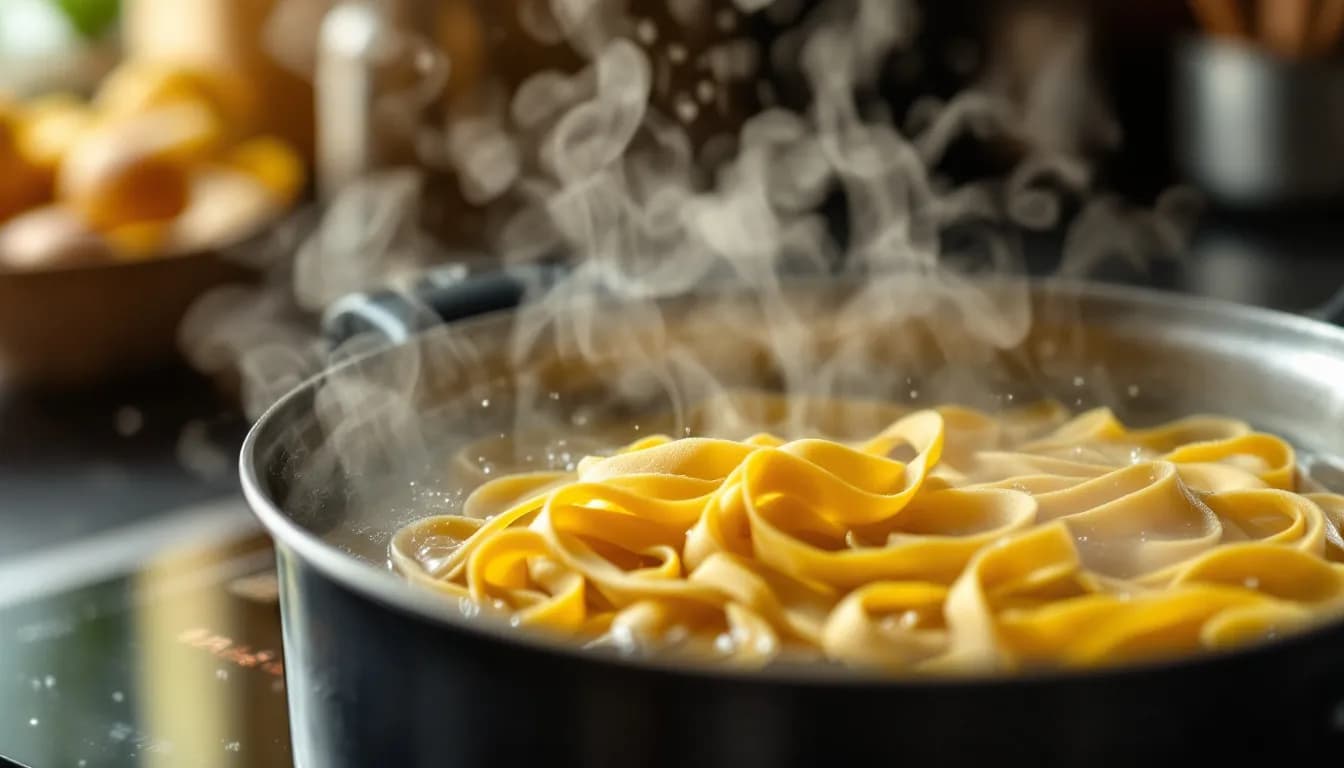
The age-old rule holds in three figures: 1 litre of water, 10 grams of salt, 100 grams of pasta. No less. Too little water overloads the starch and makes the pasta stick together. Too little salt gives a bland pasta that no sauce can rescue.
The salt goes in once the water is at a rolling boil, never before. Use coarse sea salt, which dissolves quickly without stinging the palate. Oil in the cooking water is an Italian heresy: it stops the sauce from clinging afterwards. Simply stir the pasta the moment it goes in, then every two minutes.
Cooking time: read the packet and subtract
Every good Italian producer prints two times on the packet: the classic cooking time and the al dente time, usually one minute shorter. This indication is a starting point, not a truth. Depending on the hardness of your water, the altitude and the briskness of the heat, allow 30 seconds of leeway.
The professional method is to taste a piece 90 seconds before the stated time. Cut it in half: the core should show a thin white dot, the sign that the central starch has not yet gelatinised. That is al dente. Beyond it, the pasta is cooked all the way through and will lose its hold in the sauce.
Draining and finishing in the sauce
Draining does not mark the end of cooking, it marks its shift. Always keep a ladleful of cooking water before draining. This water, rich in starch, binds the sauce and lets you adjust the consistency.
Pasta is never rinsed. It goes straight from the colander to the pan where the sauce is waiting, already hot. You toss it for a minute over a high heat, adding the reserved water in small amounts. This is the gesture of mantecatura: the residual starch emulsifies with the fats in the sauce and coats every piece evenly.
The al dente method
- 1 litre of water and 10 g of salt per 100 g of pasta, never any oil
- Salt added at a rolling boil, pasta dropped in and stirred from the start
- Cooking stopped 1 minute before the stated time, tasted 90 seconds before the end
- Ladleful of cooking water kept before draining, never rinse
- Mantecatura in a hot pan, serve immediately
The shape of the pasta calls for its sauce
The common mistake is to choose the pasta for its appearance and the sauce for the craving, without linking the two. The Italians have codified these pairings over centuries. Long, smooth pasta (spaghetti, linguine) welcomes fluid sauces based on oil, garlic and crushed tomato. Short ridged pasta (penne, rigatoni) traps thick sauces of meat or vegetables.
The more complex shapes (orecchiette, conchiglie, fusilli) are designed to hold granular sauces, broken up with sausage, broccoli, ricotta. A carbonara on farfalle is technically possible but structurally weak: the sauce runs off, it does not catch.
Getting al dente right ultimately means chaining a sequence of timed gestures without hesitation: salting at a rolling boil, tasting before the end, keeping a ladleful of cooking water and finishing in the pan. Once these reflexes are second nature, the choice of shape and its sauce becomes the only real freedom that remains.
In echo
Italian cuisine cannot be reduced to its recipes, it also rests on an art of living that resurfaces in the way a kitchen is laid out. That is the spirit of a Mediterranean kitchen, where conviviality guides the materials and the light. This Italian heritage runs through the signature of the Sistema collection too.