Patisserie is not up for debate, it is measured. Unlike savoury cooking, where you adjust by tasting, here everything is decided before baking: the temperatures, the proportions, the exact order of the gestures. Learning the basic techniques is what gives you the freedom to improvise afterwards.
Creaming, rubbing in, whipping: choosing the right method
Three gestures structure most sweet doughs. Creaming means working softened butter with sugar until you obtain an airy, pale texture. It is the basis of loaf cakes, cookies and pound cakes. The butter must be at 18-20°C, neither melted nor hard.
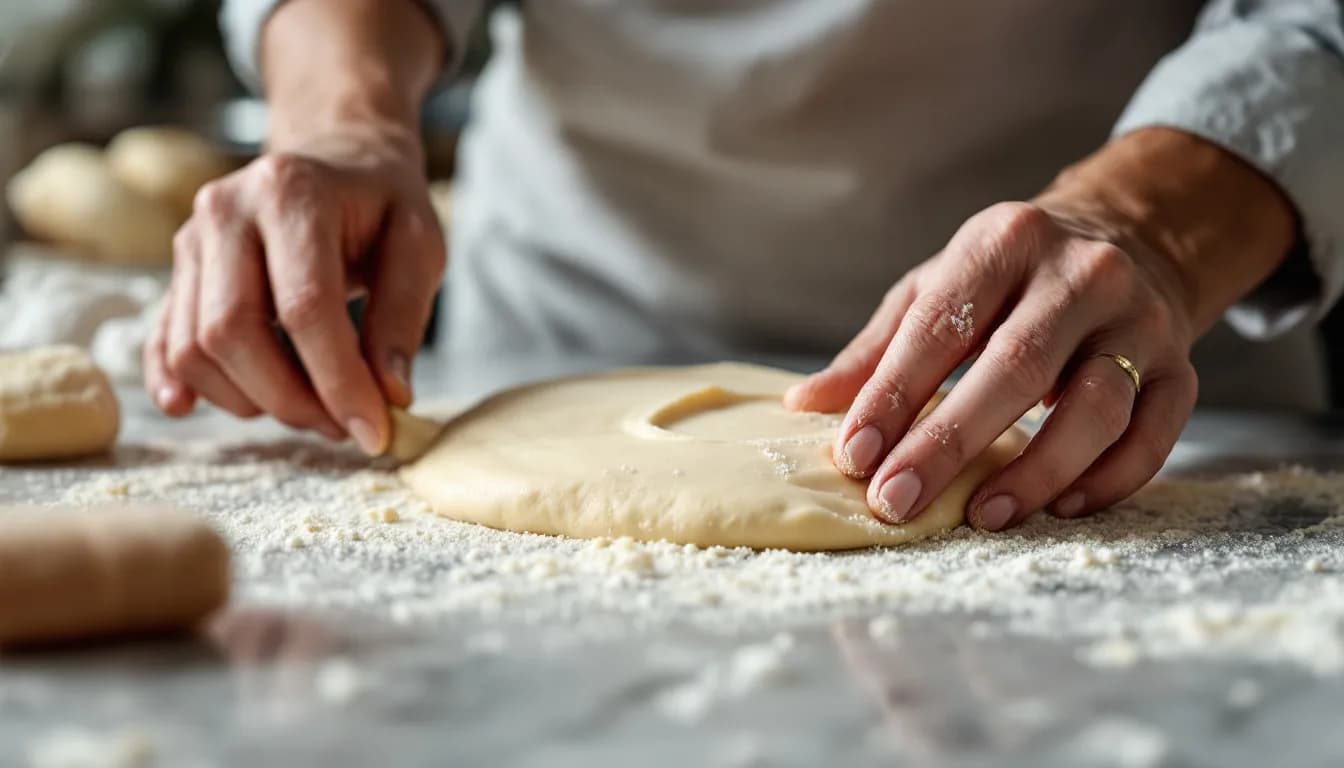
Rubbing in means working cold butter into the flour with your fingertips or with the paddle, until you obtain a grainy powder. It is the technique of shortcrust and sweet pastry, where the butter coats the flour and blocks the development of gluten. The result: a crumbly dough, never elastic.
Whipping applies to eggs and cream. You incorporate air by fast whisking until the volume doubles or triples. Whipped cream is worked between 2 and 4°C, in a cold bowl, otherwise the fat splits.
Three founding gestures
- Creaming: softened butter at 18-20°C worked with sugar, the basis of cakes and cookies
- Rubbing in: cold butter crumbled into the flour, a crumbly dough never elastic
- Whipping: eggs or cream whisked cold to double the volume
Mastering temperatures: the real craft
A pastry chef does not read a recipe, they read a thermometer. Choux pastry is dried out at 75°C in the pan before the eggs are added. A crème anglaise is cooked at 83-85°C, never beyond, or the yolks coagulate. A dry caramel is taken between 160 and 180°C depending on the use: light amber to coat, dark to flavour.
Tempering chocolate is the most demanding example. For dark chocolate, the classic curve: melt at 50-55°C, drop to 28-29°C, raise back to 31-32°C. Outside this range, the cocoa butter does not crystallise properly and you end up with a dull chocolate that blooms.
75°C
Choux pastry
83-85°C
Crème anglaise
31-32°C
Dark chocolate tempering
160-180°C
Dry caramel
Cold, the silent partner
A sweet pastry rests in the fridge for at least 2 hours before rolling out. A puff pastry calls for 4 to 6 turns with a 30-minute rest between each. Cold relaxes the gluten network and stabilises the butters.
Working on a cold surface changes everything. Marble, traditionally used in professional patisserie, keeps its coolness even under a warm lamp. Quartz now offers a very high-performing alternative, with comparable thermal inertia and resistance to acids. A cold 60x40 cm slab is enough to roll out a dough or temper chocolate without it softening mid-gesture.
Ingredients: precision before creativity
Patisserie tolerates approximation poorly. A scale accurate to the gram is essential, including for liquids (a whole egg weighs 50 g on average, a yolk 20 g, a white 30 g). Eggs are worked at room temperature for beaten batters, cold for stiffly beaten whites.
The flour is chosen according to use: T45 for fine doughs and viennoiserie, T55 for shortcrust and sweet pastry. Caster sugar incorporates quickly, icing sugar gives a melting quality but holds moisture.
In the end, patisserie rewards rigour before imagination: an accurate scale, a reliable thermometer, a cold worktop and respect for the resting times. Once these fundamentals are mastered, the most ambitious recipes stop being intimidating and become a simple sequence of familiar gestures.
The final word
A good worktop is one of the fundamentals, on a par with the thermometer. Marble or quartz, a cold and stable surface transforms the experience of the gesture. It is also what guides the architecture of Sistema kitchens, whose worktops invite you to see and touch in the showroom before choosing your material.