A comfortable kitchen is not, first and foremost, a decorated kitchen. It is a kitchen where you move without thinking about it. Three or four silent rules govern that fluidity, inherited from the domestic ergonomics studies of the twentieth century and still relevant today. Properly understood, they determine almost everything else, from the layout right down to the choice of tap.
The work triangle
The principle of the work triangle, formalised in the 1940s, remains the first rule to know. It links three poles: the cold, meaning the fridge, the water, meaning the sink, and the heat, meaning the cooking zone. The sum of the three sides should ideally stay between 4 and 8 metres, with each segment between 1.20 and 2.70 metres. Below that, you bump into things; above it, you wear yourself out. A layout that respects this triangle saves several hundred steps a day. It applies to galley kitchens as much as to L-shaped, U-shaped or island kitchens, adapting the placement of the three poles to the geometry of the room each time.
Clearances
The second constant concerns clearances. Between two runs of units, for example between an island and the cooking wall, allow at least 90 centimetres when one person cooks, 100 to 120 centimetres when two people share the space, and up to 130 when a dishwasher or oven opens its door towards the passage. Below 90 centimetres, two bodies can no longer pass each other, and every open drawer becomes an obstacle. Think too about the frontal clearance in front of the oven and dishwasher, which is measured not at floor level but with the door open. Smooth circulation is designed at shoulder height as much as at foot height.
90 cm
Island and galley
120 cm
Crossing zone
60-70 cm
Worktop depth
70-90 cm
Sink zone radius
| Situation | Minimum clearance |
|---|---|
| One person cooking | 90 cm |
| Two people passing each other | 100 to 120 cm |
| Oven or dishwasher door open | 120 to 130 cm |
| Chair pulled out from a table facing an island | 90 cm |
The direction the doors open
The direction the doors open often decides more than the position of the units. A fridge door that opens towards the passage cuts the kitchen in two, whereas a door that opens towards the wall disappears. An oven door that drops down in front of the island creates a dangerous step; a side-opening or retractable door removes it. Before settling on a layout, simulate the simultaneous opening of the oven, the dishwasher and the fridge in the middle of a cooking session. If two doors touch or block a passage, the layout is not finalised. This detail, often overlooked, makes all the difference between a functional kitchen and a tiring one.
The kitchen open to the living room
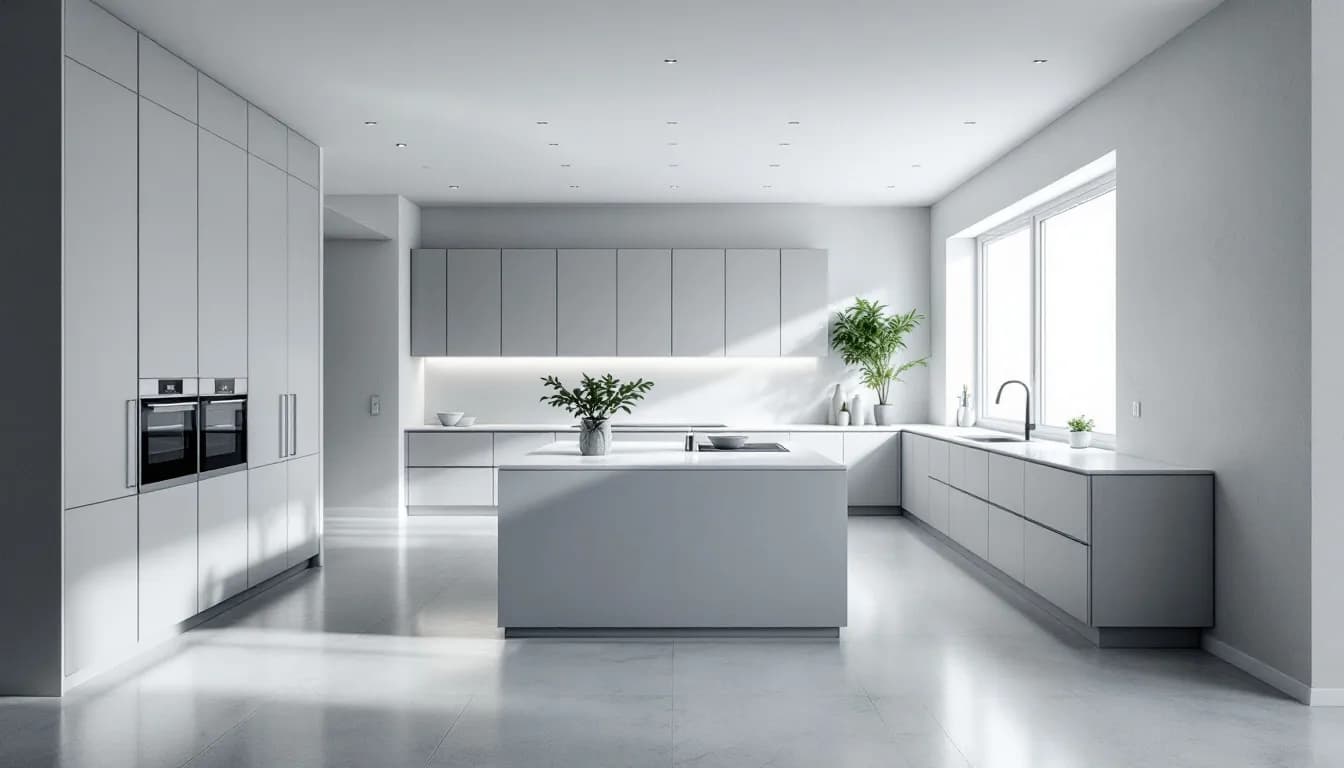
In today's homes, the kitchen increasingly opens onto the living room, which adds a constraint: circulation extends into the living space, just as ventilation and air flow must also account for the whole volume. The island then becomes the threshold between the two worlds. For it to remain workable, the passage behind the island must keep the same clearances as in front. If the living room has a dining table, allow 90 centimetres between the pulled-out chair and the island. Smooth circulation in an open kitchen is measured across the whole room, not just the work zone.
These few rules, work triangle, clearances and the direction doors open, are not visible once the kitchen is in place. That is precisely the sign of success: a well-tuned kitchen is crossed without a thought, and all the comfort lies in what you no longer have to correct day to day.
Going further
Circulation is only one side of ergonomics: worktop heights, lighting and taps answer the same demand for a space you inhabit effortlessly. To connect these adjustments together, see our principles for an ergonomic and safe kitchen, which naturally complement the rules covered here.