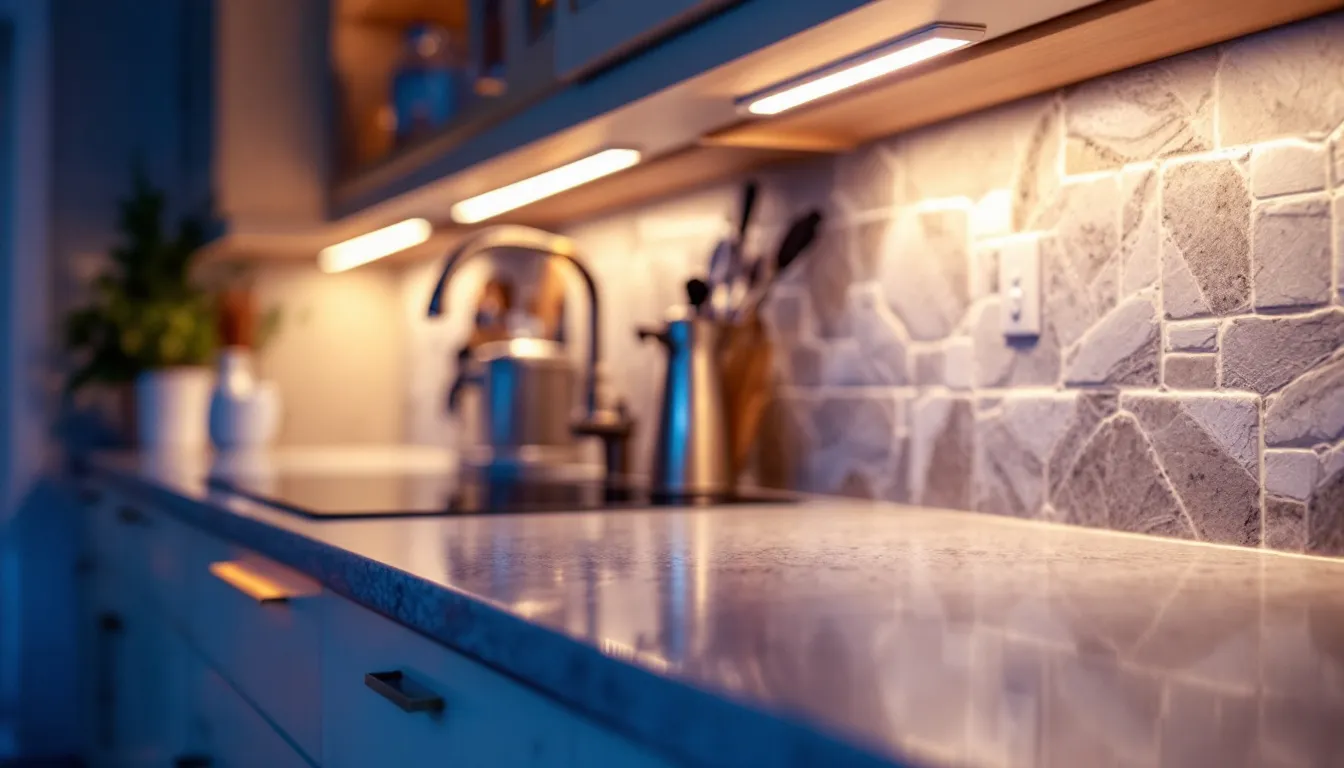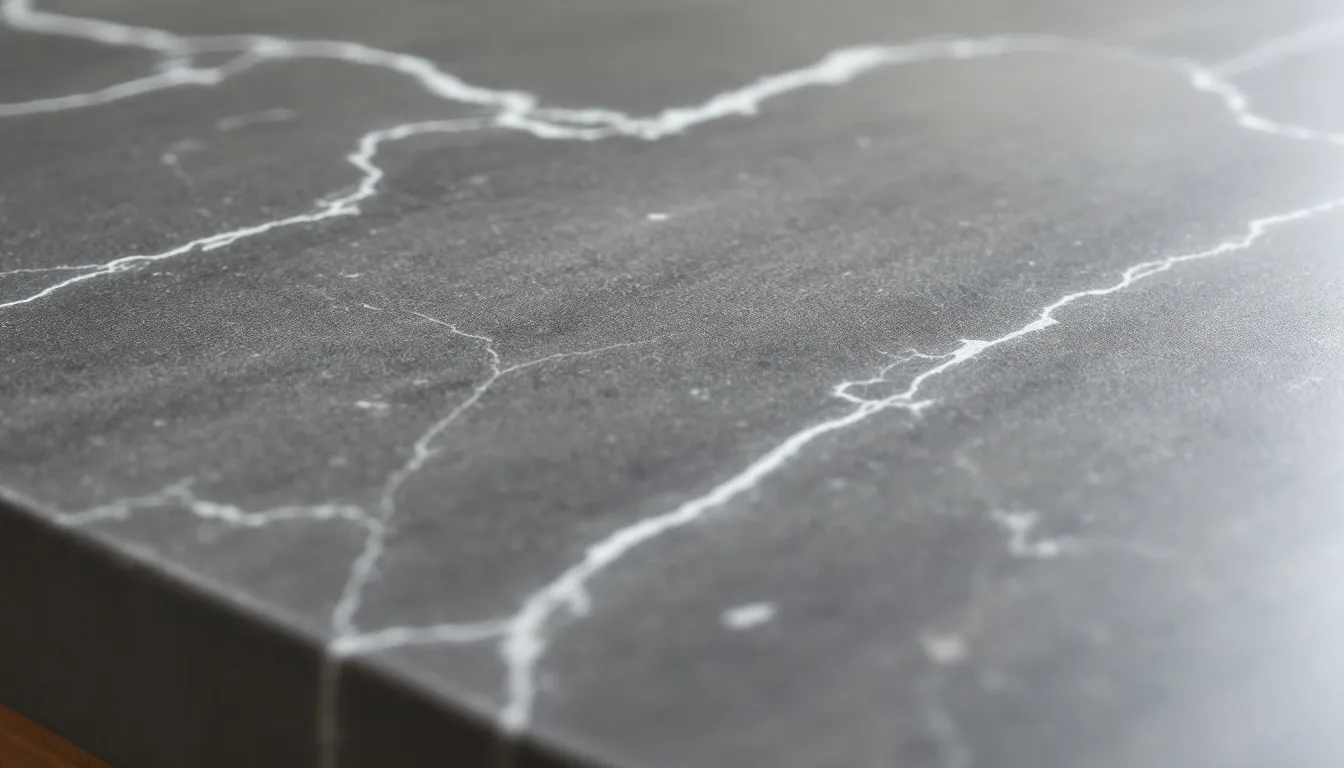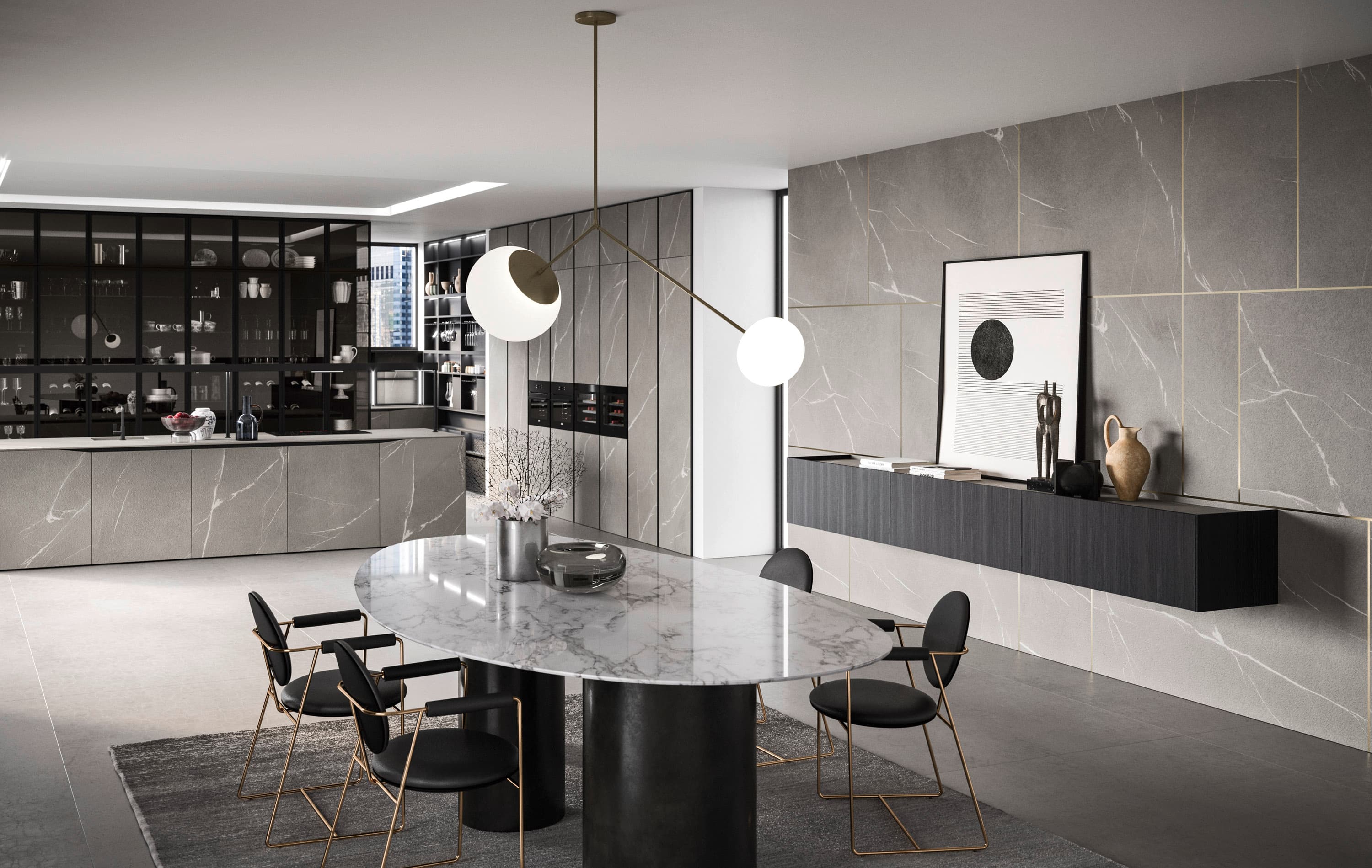
Engineered quartz has held a central place in contemporary kitchens for twenty years. Its promise has not aged: a dense, non-porous surface, with a perfectly uniform colour along the full length of the worktop. Here is what this material really involves, and where it keeps its edge over ceramic or natural stone.
What we call quartz in the kitchen
The quartz used for worktops is not a slab of quartz extracted as it is. It is a composite, 90 or 93% natural quartz aggregates bound by a polymer resin, to which pigments are added. The benchmark brands, Silestone and Caesarstone foremost among them, each have their own formula and palette.
This manufacturing process explains the visual uniformity of the material. Where natural stone shows variations from one slab to the next, engineered quartz guarantees an identical colour and pattern across an entire kitchen, even over very long runs.
The uses where quartz remains unbeatable
Quartz is particularly suited to heavily used kitchens and to families. Its non-porous surface resists common stains: red wine, coffee, fruit juice, oils. No impregnation, no lasting marking, provided you wipe within the following hours.
Its density, higher than that of granite, makes it very resistant to everyday scratches. A chopping board is of course still advisable, but a dropped knife or the scrape of a pan does not mark the surface.
Quartz tolerates heat up to around 150°C in direct contact. Beyond that, the resin can yellow or shrink, creating a permanent mark. This is its main limit against ceramic, which fears no heat source.
| Criterion | Quartz | Ceramic | Marble |
|---|---|---|---|
| Heat resistance | Up to 150°C | Unlimited | Good, but marking possible |
| Porosity | None | None | High, sealing required |
| Acid sensitivity | None | None | Very sensitive (lemon, vinegar) |
| Colour uniformity | Perfect | Very good | Variable from slab to slab |
| Scratch repair | Possible by sanding | Difficult | Possible by sanding |
Behaviour under UV: an underrated criterion
Not all quartz performs the same when exposed to sunlight. The first generations of products slowly yellowed by a window or on a very exposed island. Current formulations, particularly those intended for outdoor use, have almost eliminated this phenomenon, but the criterion is worth raising.
For an island facing due south, behind a large glazed bay, explicitly ask for a UV-stabilised reference. Manufacturers specify this compatibility on their technical sheets. On a perimeter worktop set back from direct light, this point has no bearing.
Choosing a colour that does not tire
Engineered quartz comes in pure whites, in greys with marbled patterns, in deep blacks, and in warmer tones inspired by limestone or sandstone. The contemporary marbled patterns, much in demand, give a look close to Calacatta, with a regularity that genuine stone never offers.
Avoid colours that are too neutral if your kitchen lacks relief. Avoid very busy patterns if you already have a striking floor or a worked splashback. The worktop is the largest visible surface in a kitchen: it sets the tone, it does not underline it.
Our view
Quartz often comes down to a neglected detail: the design of the edge. A fine square edge, an ogee edge, or a solid six-centimetre edge for an island that asserts itself, each option changes the perceived density of the material. A highly architectural structure such as Elementi takes advantage of its pronounced island returns to give the Calacatta patterns a balanced reading, neither showy nor faded. The reference is then chosen on a real slab, never on a sample: it is the only way to judge the uniformity of colour over a long run.