A poorly lit worktop tires the eyes, slows down chopping and distorts the perception of a food's colours. Yet it is the most used area of the kitchen and the most demanding in terms of light. Lighting the worktop never comes down to a single LED strip beneath the wall units. It combines a source dedicated to the task, careful integration into the unit, and consistency with the general atmosphere of the room.
500 lx
Task area
3000K
Warm white
CRI 90+
Faithful rendering
90 cm
Worktop height
A light dedicated to the task, not to the atmosphere
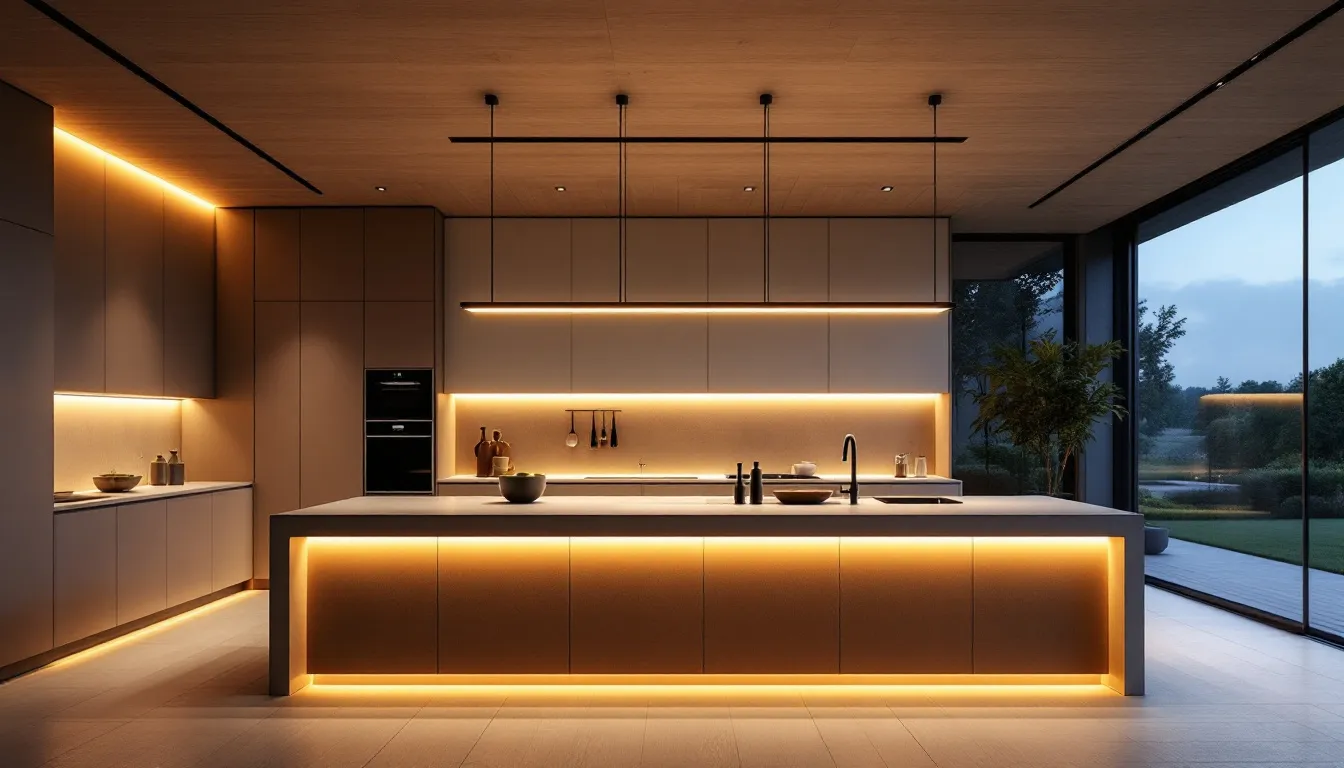
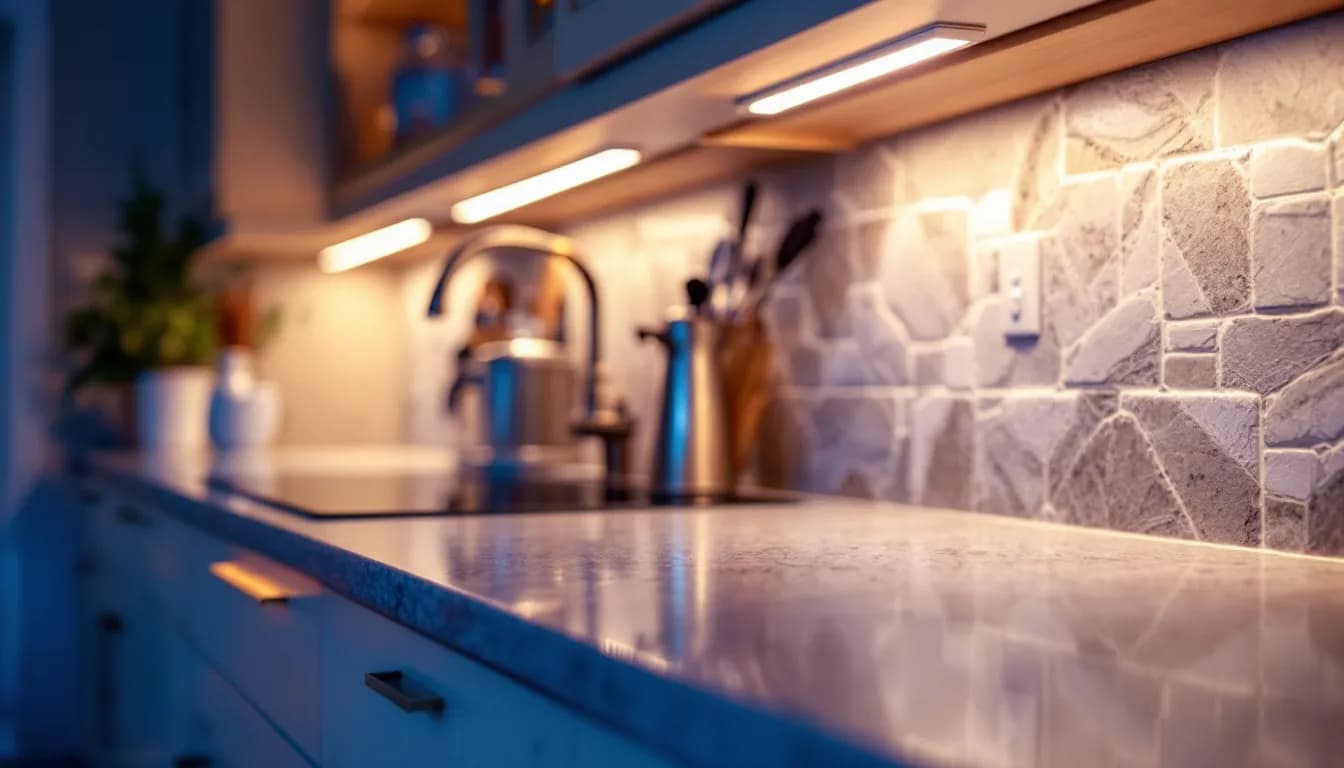
The worktop calls for task lighting, what lighting designers call functional lighting. The aim is to achieve 300 to 500 lux on the surface, measured at the level of the worktop, which goes well beyond the ambient lighting of a living space. This intensity must be directional, that is, cast from above onto the worktop, and close enough not to create a shadow thrown by the hands or the body of the person cooking. A pendant fixed to the ceiling is never enough. You need a source integrated beneath the wall units or housed in a drop, roughly 50 to 60 cm above the worktop, aligned with the front edge so the light falls on the work area, not on the splashback.
Colour temperature, a compromise
On a worktop, the light has to be cool enough to stay legible, warm enough not to distort food or clash with the general atmosphere. The useful range runs from 3000K to 3500K. Below that, the contrasts fade, which hampers chopping. Above it, the light turns a cold white and tires the eyes over a long session. The colour rendering index matters as much as the temperature, so aim for a CRI above 90 so the reds of a tomato or the greens of a herb stay true. Some LED profiles today let you switch between two whites, a neutral white when working and a warm white in the evening, which elegantly resolves the compromise.
Integration into the unit, the condition for a fine result
A visible LED strip screwed beneath a shelf is rarely satisfactory. Integration relies on a profile recessed into the underside of the wall unit, with an opal diffuser that softens the source and prevents glare when you are seated at the island. The recess height must be worked out when the unit is drawn, not added afterwards. A few millimetres in the wrong place and the light throws a blinding reflection across the sintered stone or quartz worktop. The power supply, the driver, the joining of lengths, all of it must be planned upstream so it stays invisible. This discretion makes the difference between off-the-shelf kitchen lighting and the lighting of a designed kitchen.
Reinforcing the critical areas
The main worktop is not the only area to light. The sink almost always deserves a directional spotlight of its own, especially if it faces away from the room and the under-cabinet strip is masked by the body. The cooking zone, if it sits on an island with no wall unit above, calls for a dedicated pendant or recessed ceiling spotlights, aligned with the worktop and adjustable. A glazed wine cabinet, a culinary library, a worktop return at counter height, all of these are areas that benefit from a localised source so they do not become visual black holes.
Three sources, three roles
- Recessed LED strip beneath the wall unit, diffuse light over the worktop
- Adjustable directional spotlight over the sink and the cooking zone
- A dimmable accent lamp, a gentle transition into the evening atmosphere
Going further
A well-lit worktop comes down to four simple settings: a directional task source reaching 300 to 500 lux on the surface, a position brought forward to the front edge of the wall unit to remove the cast shadow, a temperature between 3000K and 3500K with a CRI above 90, and integration into a recessed profile planned from the moment the unit is drawn. These decisions are made before installation, because none of them is easily put right once the wall units are fixed. Once the task area is settled, all that remains is to tune it to the rest of the room: see how to create a warm atmosphere with soft, dimmed lighting so the worktop converses with the evening light.