An open kitchen is no longer quite a kitchen, not yet a living room, and it is precisely this ambiguity that needs lighting. Three uses share the same volume, preparation, dining, everyday living. Each calls for a different intensity, temperature and direction of light. The role of the lighting designer, or of the kitchen designer, is to orchestrate these three layers without breaking the unity of the room.
Think in zones, not in light fittings
The classic trap is to draw a ceiling plan from a catalogue of light fittings, spreading spotlights at regular intervals. The result lights the room but tells no story. The useful approach starts by identifying the zones of use. The preparation zone, around the sink and the hob, calls for functional, directional light, of the order of 300 to 500 lux, a subject we go into in our guide on lighting the worktop effectively. The dining zone, whether at the island or at a dedicated table, calls for warm, concentrated light that anchors guests around the tabletop. The living zone, lounge, reading, television, calls for diffuse ambient light, low in intensity. Once these zones are set, the light fittings almost choose themselves.
| Zone | Lux level | Temperature |
|---|---|---|
| Preparation | 300 to 500 lx | 3000 to 3500K |
| Dining | 150 to 250 lx | 2700K |
| Living | 100 to 150 lx | 2700K |
Layer three levels of light
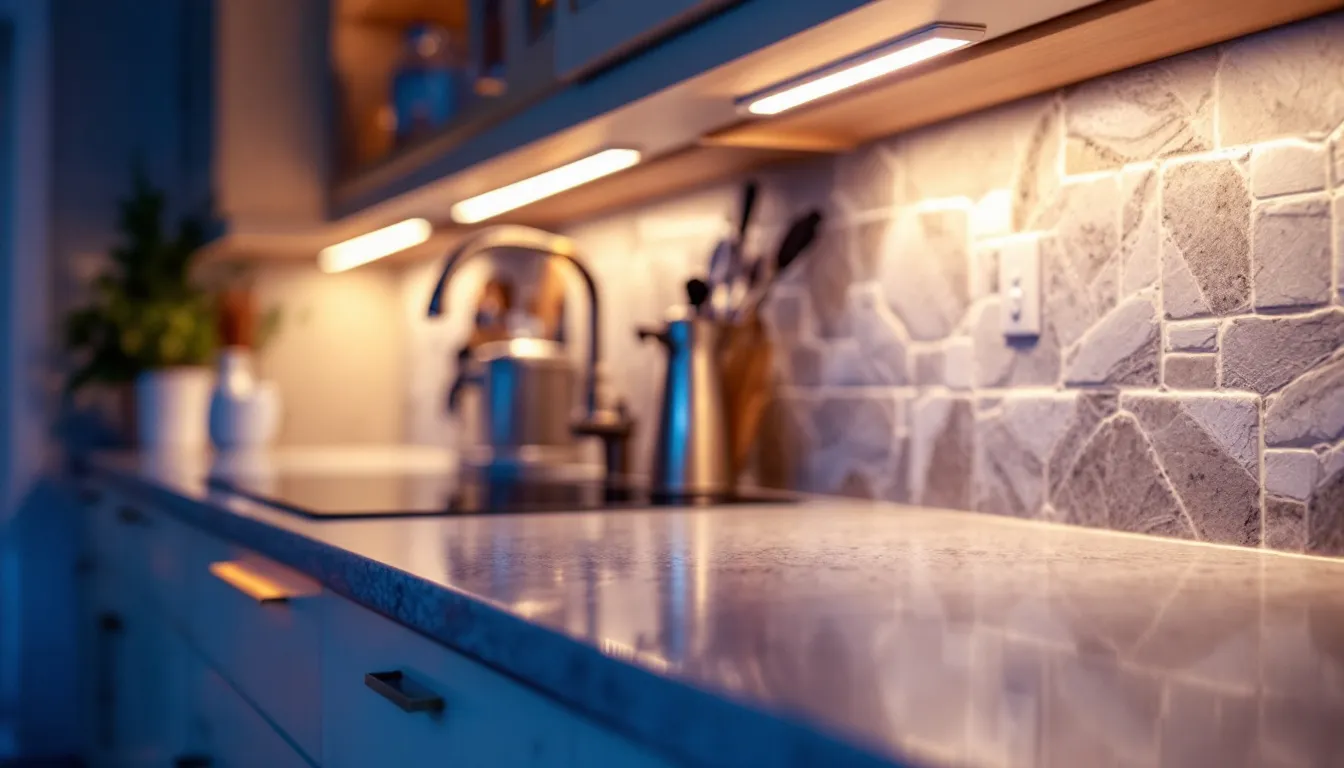
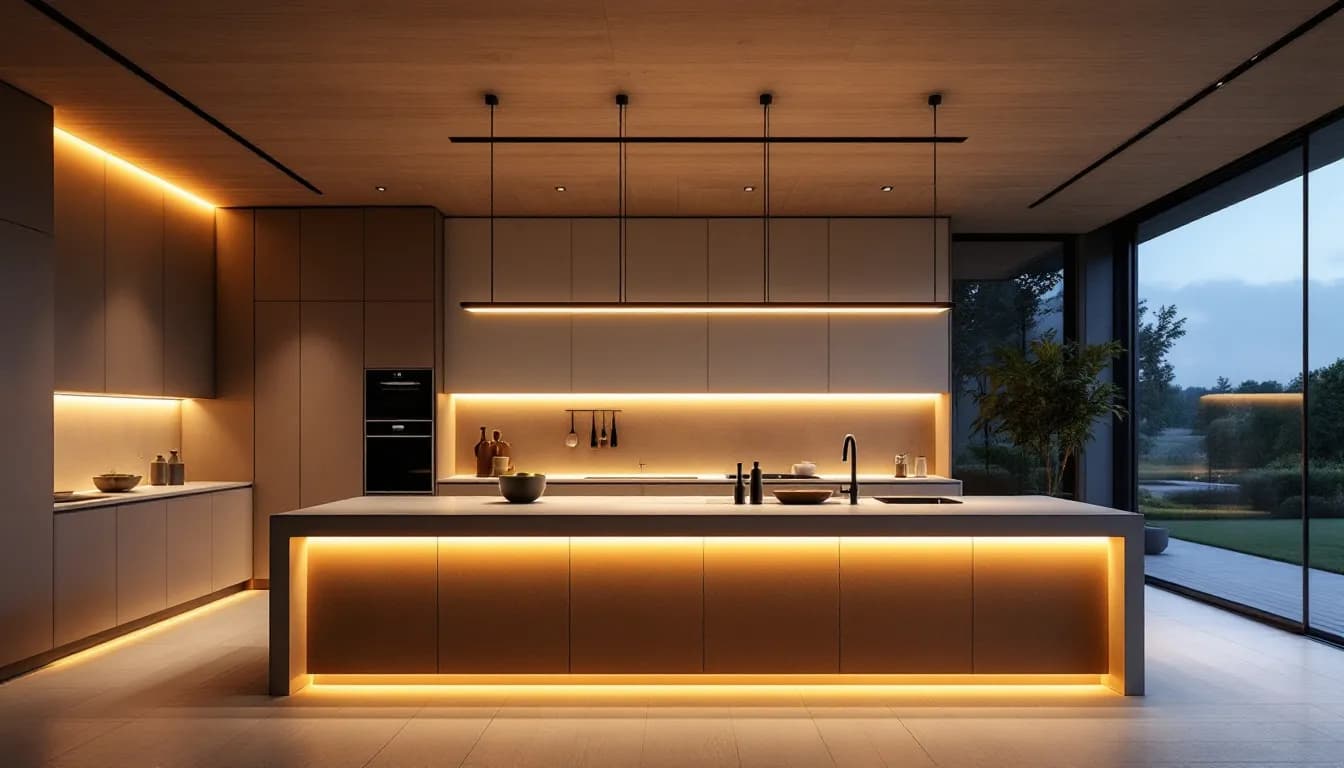
The three-layer rule structures any reasonably serious residential lighting project. The first layer, general lighting, provides a comfortable background brightness, often via recessed ceiling spots or indirect cornice lighting. The second layer, task lighting, handles the precise zones, worktop, table, hob, with dedicated and more intense sources. The third layer, accent lighting, highlights an element, a stone splashback, a bookcase, an artwork, and gives the room its depth. These three layers must be controllable independently, ideally programmed into scenes, so the room can switch from a serving scene to an after-dinner scene with no fuss.
The three layers
- Ambient, diffuse background light, indirect where possible
- Task, dedicated sources on the worktop, table, hob
- Accent, highlighting a splashback, an artwork, a bookcase
Coherence of colour temperature
In an open space, nothing looks more amateurish than a mix of temperatures. A kitchen corner at 4000K next to a living room at 2700K creates a visual boundary that destroys the sense of openness. The rule is simple, choose a dominant temperature for the whole zone, generally 2700K to 3000K, and accept pushing it slightly towards 3000K to 3500K on the task zones alone, the worktop included. The colour rendering index, the CRI, should stay consistent and above 90 everywhere. This discipline is invisible when done well, and brutal in its absence.
Build the sources into the architecture
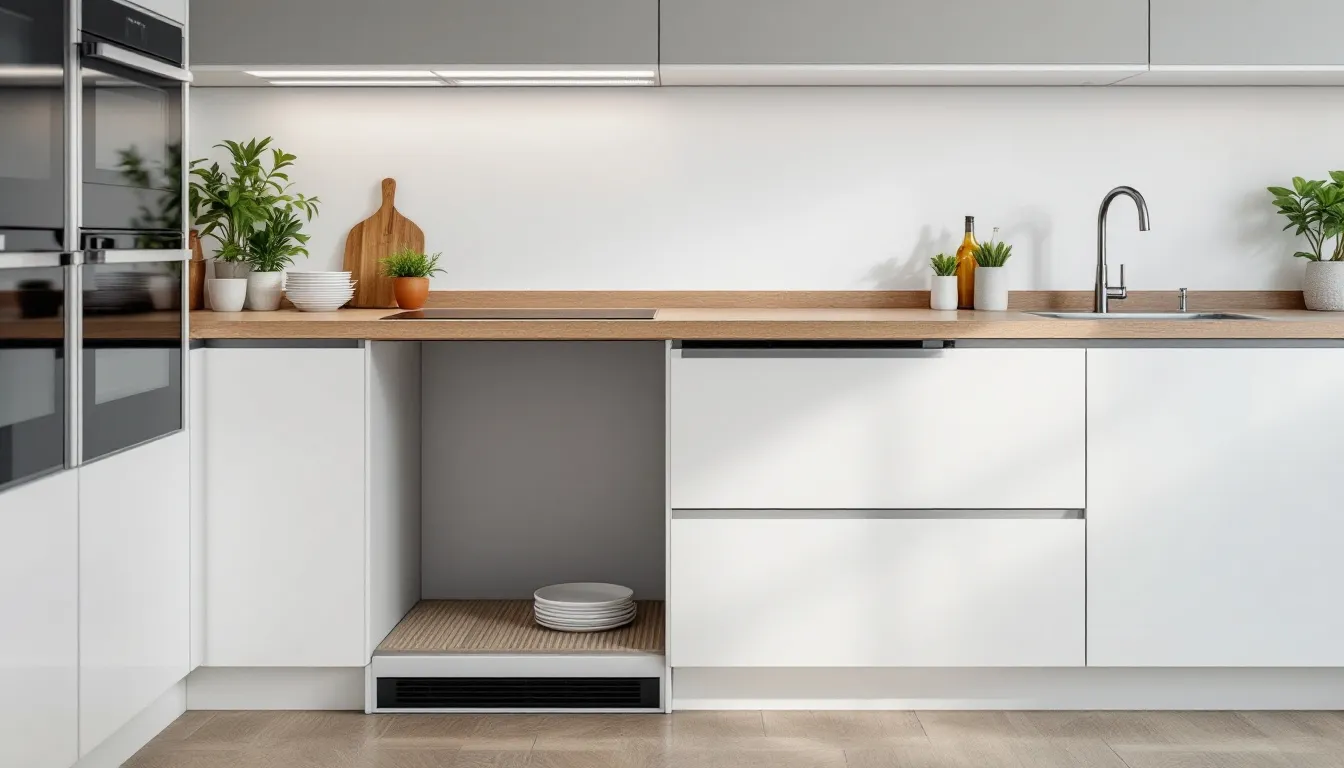
In an open kitchen, light is better lodged within the architecture than added on top of it. A dropped ceiling between the kitchen corner and the living corner is the ideal place to house an indirect strip and directional spots. A low plinth under the island takes grazing light that makes the block float and stretches the floor. A high shelf, a back panel, a niche, all are supports for discreet sources that disappear in daylight and structure the room in the evening. This integration means thinking about it at the design stage, not after, which is one of the strengths of a kitchen conceived as a project rather than as simple fitting-out.
A final word
An open kitchen is only well lit if the light is drawn together with the volume, and not laid over it once the blocks are in place. It is this logic of continuity that the layouts designed for the kitchen-living continuum push, such as the Living collection, whose high cornices and island overhangs build the indirect sources into the furniture itself. The principle stays independent of the furniture chosen: lay down the three layers at the design stage, and the room will be able to switch from serving to evening effortlessly. To take the reflection on evening atmosphere further, see also how to create a warm atmosphere with subdued lighting.